

A few weeks ago, we looked at the charity funding crisis in the UK in numbers: £14 billion in annual giving, four million fewer donors than a decade ago and nearly half of the sector operating at a deficit.
Funding is only part of the picture. Charities also face significant challenges in recruiting and retaining the people needed to deliver their work.
The figures in this article come from the Voluntary, Community and Social Enterprise Sector Barometer, a quarterly survey run by the VCSE Data and Insights National Observatory and led by Nottingham Trent University. Its April 2026 survey received responses from 444 organisations across the UK.
Most of the respondents were relatively small. Just over half were classified as small by income, while 55% employed ten people or fewer. The findings therefore provide a useful indication of the pressures facing smaller voluntary organisations in particular.
Volunteers underpin the sector, but recruitment is difficult
Among the organisations surveyed, 98% rely on volunteers, while only 64% employ any paid staff. Volunteers are therefore central to the way much of the sector operates.
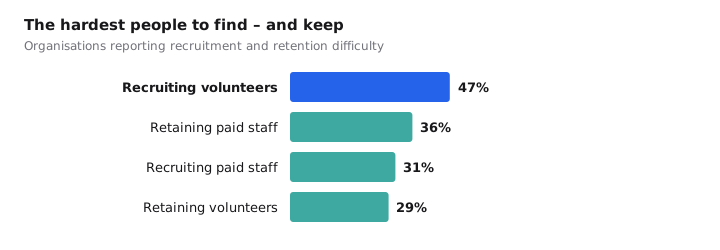
However, 47% reported difficulty recruiting volunteers, making it the most commonly reported workforce problem. By comparison, 31% had difficulty recruiting paid staff.
Volunteer recruitment was also identified by around a third of respondents as one of their main operational concerns, alongside funding pressures, rising demand and inflation.
Retention presents a further challenge. Twenty-nine per cent struggle to retain volunteers, while 36% struggle to retain paid staff. Many organisations are therefore finding it difficult both to bring people in and to keep them.
Recruitment difficulties affect service delivery
Workforce shortages can have a direct effect on the services charities are able to provide.
Among organisations experiencing recruitment difficulties, 35% had paused some operations, while approximately a third had been unable to meet demand. The most common response was to ask existing volunteers to work longer hours.
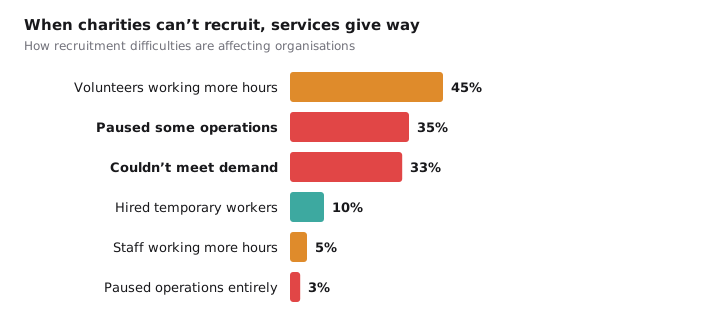
Only around one in ten had brought in temporary workers. This suggests that many charities do not have the financial flexibility to purchase additional short-term capacity. Instead, they tend to rely more heavily on existing staff and volunteers or reduce the amount of work they undertake.
Financial pressure is also workforce pressure
Financial and workforce pressures are closely connected. Staffing represents the largest area of expenditure among the organisations surveyed, accounting for an average of 43% of spending.
At the same time, 57% said their financial position had worsened, 46% were using reserves to cover everyday running costs, and 12% had no remaining reserves to draw upon.
The actions organisations have taken in response show how these pressures affect their workforces.
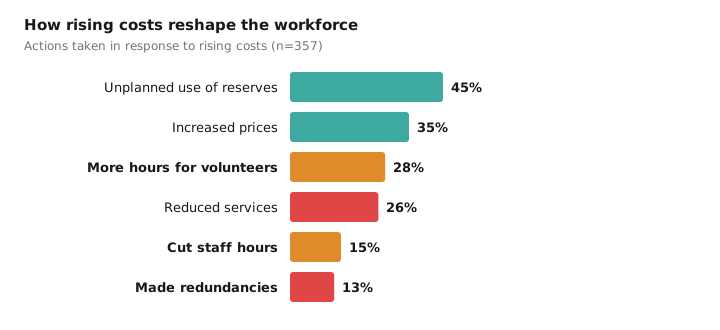
More than a quarter had increased volunteers' hours or responsibilities. Fifteen per cent had reduced staff hours, while 13% had made redundancies or released staff.
Taken together, these findings suggest that financial pressures are leading some organisations to ask more of volunteers while reducing their paid capacity.
Demand is rising faster than capacity
These workforce pressures are occurring as demand for charitable services continues to increase.
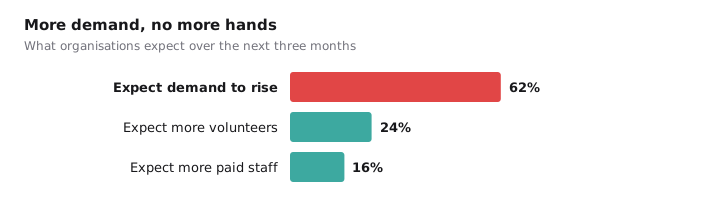
Sixty-two per cent of organisations expect demand to rise over the next three months: 43% expect it to rise a little and 19% expect it to rise substantially. Only 4% expect demand to fall.
Workforce numbers are not expected to grow at the same rate. Sixty-seven per cent expect the size of their paid workforce to remain unchanged, with similar proportions expecting it to grow or shrink. Around two-thirds also expect their number of volunteers to stay the same.
When asked about their ability to meet demand, 45% expected to do so with little or no spare capacity, while 19% expected to fall significantly short. Only around one in ten expected to have substantial spare capacity.
The survey therefore points to a widening gap between the level of need and the resources available to respond to it.
What might help
There is no single solution to these pressures. However, the findings suggest several areas in which additional support could be useful.
Contributions of time and expertise
Financial donations remain important, but charities may also benefit from access to professional skills. Support with areas such as technology, design, strategy, communications and fundraising can help organisations complete work that might otherwise be delayed or left undone.
More affordable access to professional support
Small charities are often unable to pay commercial agency rates or recruit full-time specialists. Models that provide access to experienced professionals on shorter engagements and at lower rates may help address specific gaps in capacity.
This is the area in which Rendered operates, connecting experienced professionals with charities that need additional expertise but may not have the budget for conventional commercial support.
Investment in organisational infrastructure
Support for internal systems can also improve capacity. A more effective customer relationship management system, website or operating process may reduce administrative work and allow staff and volunteers to spend more time on their organisation's core activities.
The sector's challenges are therefore not limited to funding. Many organisations are also short of staff time, volunteer capacity and the flexibility needed to respond to changes in demand. Addressing these constraints will require attention not only to how charities are funded, but also to how they access and use people's time and expertise.
Data source: VCSE Sector Barometer, Wave 14 (April 2026), VCSE Data and Insights National Observatory / Nottingham Trent University; 444 responding organisations. Individual questions have varying base sizes; percentages are rounded by the source.
Interested in what we're building?
Rendered connects skilled professionals with nonprofits for meaningful, paid project work.
Stay in the loop
Observations on matching professionals with nonprofits that need their skills. No spam. Unsubscribe anytime.